
Thalassaemia is the most common congenital disorder in Bangladesh. The carrier rate, as reported in
various research publications, ranges from 7% to 13%, with an average of 10%. Among these, the carrier
rate for the Beta trait is 4.1%, while for the Hemoglobin E (Hb E) trait, it is 6.1%. In tribal populations,
the carrier rate is even higher—35.6% for Hb E trait and 4.8% for Beta trait.
It is estimated that nearly 14,000 thalassaemia-affected children are born each year in the Bengali
population, with an additional 1,534 births in the tribal population. These numbers are alarming. The
treatment and regular blood transfusions required for these children cost crores of taka annually. Notably,
around 60% of the country’s donated blood is used solely for thalassaemia patients.
There are two major types of thalassaemic children in Bangladesh:
- Thalassaemia Major
- Hb E Beta Thalassaemia
Children with Thalassaemia Major require lifelong, regular blood transfusions, typically every month or even fortnightly. While Hb E Beta Thalassaemia presents with a range of clinical symptoms, nearly 50% of these patients also become transfusion-dependent.
Unfortunately, treatment options remain limited due to the high cost of medicines and the scarcity of safe blood. Access to these treatments is generally restricted to major urban centers like Dhaka and Chittagong.
As a result, many families cannot afford adequate treatment, leading to serious medical complications and suffering for the children.
Challenges in Prevention: Cultural and Social Realities
In many countries, public awareness, carrier detection, and discouraging marriages between carrier couples have proven somewhat effective in reducing thalassaemia births. However, in Bangladesh, this strategy faces significant social and cultural obstacles. Marriage is a deeply rooted institution involving families, traditions, and emotional bonds. Calling off an engagement due to both partners being carriers can lead to social stigma and emotional distress. Due to the fear of being labeled “unmarriageable”, many individuals avoid carrier testing before marriage. Instead, testing is more commonly accepted after marriage or during pregnancy. Reducing the stigma surrounding carrier status through education and public campaigns is crucial but will require many years of sustained effort.
Global Success Stories in Prevention
Many countries have successfully implemented thalassaemia prevention programs focused on awareness, carrier screening, prenatal diagnosis, and, where culturally or legally acceptable, selective termination of affected pregnancies. These programs have drastically reduced the number of affected births:
- Cyprus: Births of thalassaemic children reduced by nearly 96%. About 80% of this reduction was due to prenatal diagnosis and abortion, and only 5% due to separation of at-risk couples.
- Iran: Initially promoted premarital screening without success due to abortion restrictions. After a 1998 religious ruling allowed abortion for severe genetic conditions before 16 weeks, prevention success rose to 82.9%.
- Turkey: The National Hemoglobinopathy Control Program (2002) led to a 90% decrease in thalassaemia births by 2008.
- China: Widely adopted prenatal diagnosis, successfully preventing births of severely affected children.
- Pakistan (Punjab): Government-backed prenatal testing program since 2009 has significantly reduced thalassaemia births, with 7,524 prenatal diagnoses performed by 2024.
- Saudi Arabia: Despite mandatory premarital screening, 90–98% of at-risk couples proceeded with marriage. A shift is now taking place toward preconception screening.
These examples show that screening and prenatal diagnosis, especially when supported by national programs and legislation, are far more successful in reducing thalassaemia births than premarital screening alone.
Time for Bangladesh to Act
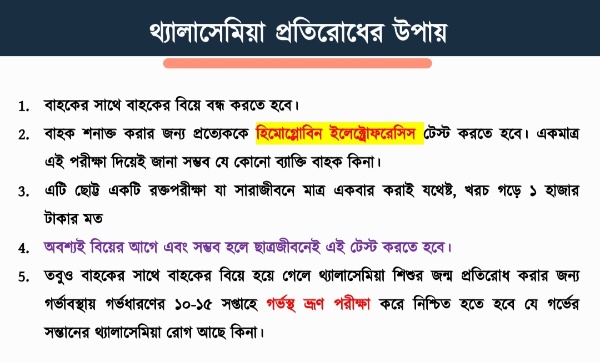
Bangladesh urgently needs to adopt a national thalassaemia prevention program, incorporating the following components:
- Public Awareness Campaigns: To educate people on the disease, its transmission, and the benefits of screening and early diagnosis.
- Carrier Screening: Government medical colleges and hospitals across all divisions should offer accessible carrier testing.
- Prenatal Diagnosis Facilities: At least four regional DNA laboratories should be established. These labs will analyze fetal DNA from chorionic villus or amniotic fluid samples.
- Training of Gynecologists: All gynecologists should be trained to:
- Recommend carrier screening during early pregnancy.
- Collect chorionic villus samples (from 11 weeks onward).
- Refer couples for prenatal counseling and testing.
- Training of Molecular Biologists and Biochemists: To carry out accurate fetal DNA analysis and determine if the fetus is a carrier, normal, or affected. If the fetus is found to have thalassaemia, informed parental consent should guide further decisions.
Islamic Perspective on Abortion
Most Islamic scholars agree that abortion for serious genetic abnormalities such as thalassaemia is permissible before 120 days (approximately 17 weeks) of gestation. The Islamic Jurisprudence Council of the Muslim World League (Mecca) issued a fatwa in 1990 allowing abortion for severe congenital conditions, including thalassaemia, before 120 days with medical and parental approval. Ultimately, the choice lies with the parents, who may also consult local Islamic scholars.
Prenatal Diagnosis: The Process
- Chorionic Villus Sampling (CVS)
- Done between 11–13 weeks of pregnancy.
- A small amount of placental tissue is collected using a needle under ultrasound guidance.
- Preferred method due to early diagnosis and legal compliance with abortion laws in Muslim countries.
- Amniocentesis
- Done after 15 weeks of pregnancy.
- A small amount of amniotic fluid is withdrawn through the abdomen using a needle.
- Drawback: Diagnosis comes later, making abortion more difficult emotionally and legally.
In both methods, DNA analysis determines whether the fetus is normal, a carrier, or affected. If the fetus is thalassaemic, the parents are counseled about lifelong treatment needs—regular transfusions, iron chelation therapy, complications, and the psychological, financial, and social burdens.
Current Status in Bangladesh
DNA analysis for prenatal diagnosis has been performed at the Bangladesh Shishu Hospital for the last eight years. However, 95% of the cases tested were from mothers who already had a thalassaemia child. These mothers, having experienced the challenges of managing the disease, are more likely to seek testing. This highlights the need for early testing among newly married or pregnant couples, not just those with prior experience.
Conclusion
Prevention is the only sustainable strategy to reduce the burden of thalassaemia in Bangladesh. The time has come for our government to act decisively—by investing in awareness, carrier screening, prenatal diagnostic infrastructure, and training of healthcare professionals. This initiative will save thousands of children from a life of suffering, reduce the financial burden on the health system, and ensure a healthier future for the next generation.